Current issue
Online first
Archive
About the Journal
Aim and Scope
Scientific Board
Editorial Board
Publisher
Reviewers
Personal Data Protection
Repository policy
Contact
AI Policy
Preprints policy
Information for authors
Paper preparation manual
Review procedures
Publishing Ethics Guidelines
Crossmark Policy
Procedures protecting authentic authorship
Plagiarism check
Copyright
Open Access Policy
Preprints policy

REVIEW PAPER
Interoperable hydrogen refueling station interface for railway vehicles in the Rail4Earth project: design approach and new normative requirements

1
Sieć Badawcza Łukasiewicz - Instytut Elektrotechniki, ul. Pożaryskiego 28, 04-703, Warszawa, Poland
Submission date: 2025-12-17
Final revision date: 2026-02-05
Acceptance date: 2026-02-10
Online publication date: 2026-02-12
Publication date: 2026-02-12
Corresponding author
Beata Kondratowicz-Kucewicz
Sieć Badawcza Łukasiewicz - Instytut Elektrotechniki, ul. Pożaryskiego 28, 04-703, Warszawa, Polska
Sieć Badawcza Łukasiewicz - Instytut Elektrotechniki, ul. Pożaryskiego 28, 04-703, Warszawa, Polska
Rail Vehicles/Pojazdy Szynowe 2025,3-4,42-47

KEYWORDS
TOPICS
ABSTRACT
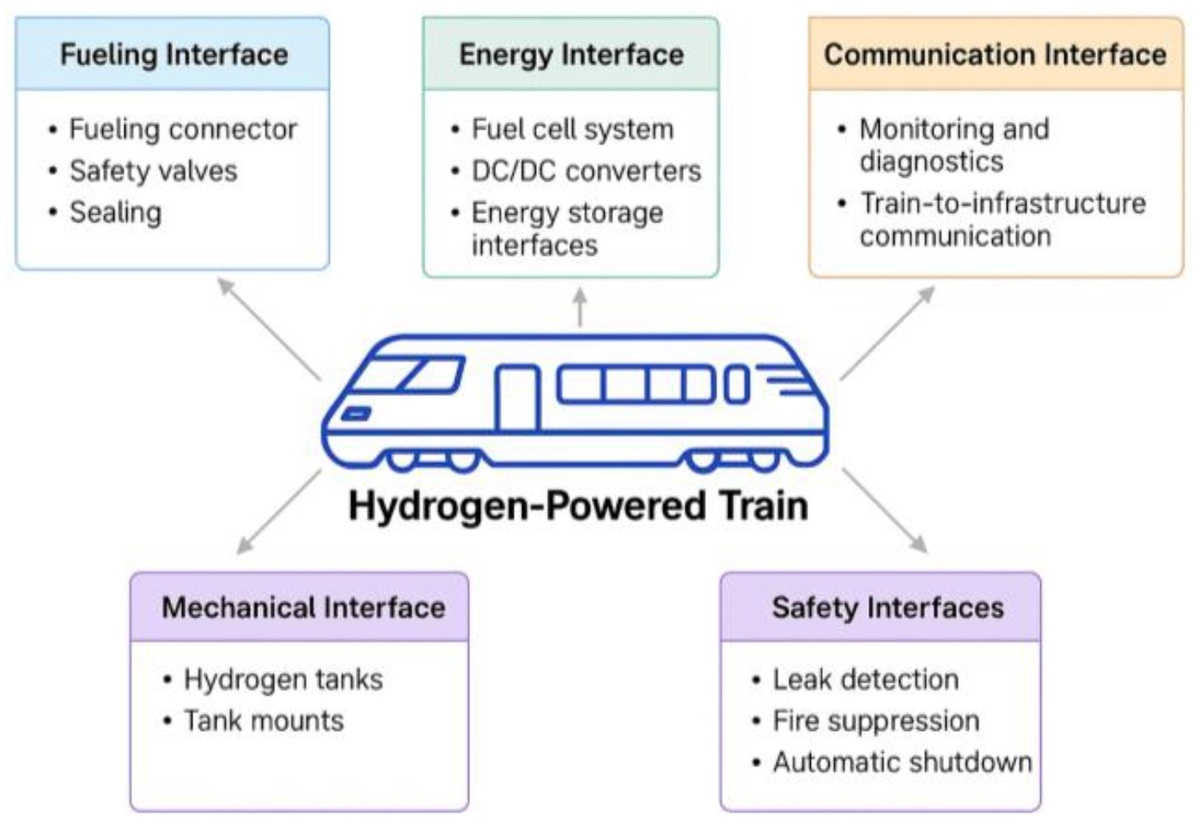
The RAIL4EARTH project, carried out under the Europe’s Rail Joint Undertaking (ERJU), focuses on the decarbonization and sustainable development of railway systems. One of its key areas is the development of interoperable and safe hydrogen refueling stations for rail applications. This paper presents the research and development activities conducted within Work Package WP9, including the analysis of technical interfaces (mechanical, electrical, communication, and safety) and ensuring compliance with SAE J2601, while being informed by the SAE J2601/5 Technical Information Report (TIR). The engineering challenges related to the design of hydrogen refueling connectors for trains are discussed, with particular attention to high mass flow rates, material requirements, and operational safety. The final outcome of the R&D work will be the demonstration of a universal refueling interface compliant with European and global standards, enabling the rapid deployment and commercialization of hydrogen technologies in the railway sector.
REFERENCES (12)
1.
Alstom. Coradia iLint: The world’s first hydrogen powered train. Saint-Ouen-sur-Seine: Alstom; 2020. https://www.alstom.com/solutio... (accessed on 23.10.2025).
2.
European Commission. A hydrogen strategy for a climate-neutral Europe. COM(2020) 301 final. Brussels: European Commission; 2020. https://eur-lex.europa.eu/lega... (accessed on 23.10.2025).
3.
European Commission. Fit for 55 packages. Brussels: European Commission; 2021. https://commission.europa.eu/s... (accessed on 23.10.2025).
4.
European Commission. Sustainable and Smart Mobility Strategy. Brussels: European Commission; 2020. https://transport.ec.europa.eu... (accessed on 23.10.2025).
5.
European Commission. The European Green Deal. Brussels: European Commission; 2019. https://commission.europa.eu/s... (accessed on 23.10.2025).
6.
International Energy Agency (IEA). The Future of Hydrogen. Paris: IEA; 2019. https://www.iea.org/reports/th... (accessed on 23.10.2025).
7.
Instytut Kolejnictwa. Możliwości zastosowania wodoru w transporcie kolejowym w Polsce (in Polish). Instytut Kolejnictwa. Prace_IK. 2021;170/6.
8.
International Organization for Standardization (ISO). ISO 17268: Gaseous hydrogen land vehicle refueling connection devices. Geneva: ISO; 2020. https://www.iso.org/standard/7... (accessed on 23.10.2025).
9.
International Organization for Standardization (ISO). ISO 19880-1: Gaseous hydrogen — Fuelling stations — Part 1: General requirements. Geneva: ISO; 2020. https://www.iso.org/standard/7... (accessed on 23.10.2025).
10.
SAE International. SAE J2601: Fuelling Protocols for Light Duty Gaseous Hydrogen Surface Vehicles. Warrendale, PA: SAE International; 2020. https://www.sae.org/standards/... (accessed on 23.10.2025).
11.
SAE International. SAE J2601/5: Fuelling Protocol for Gaseous Hydrogen Powered Heavy Duty Vehicles. Warrendale, PA: SAE International; 2024. https://www.sae.org/standards/... (accessed on 23.10.2025).
12.
International Union of Railways (UIC). Hydrogen trains: Main characteristics, potential and deployment scenarios. Paris: UIC; 2021. https://uic.org/ (accessed on 23.10.2025).
CITATIONS (1):
1.
Safety management for hydrogen refueling stations: A review of lifecycle-based risk identification, assessment, and prevention and control
Rong Cong, Junjie Zhu, Hui Liu, Yanhao Xu, Lina Fang, Xiaoyue Yao, Jie Kong, Hailin Zhou
International Journal of Hydrogen Energy
Rong Cong, Junjie Zhu, Hui Liu, Yanhao Xu, Lina Fang, Xiaoyue Yao, Jie Kong, Hailin Zhou
International Journal of Hydrogen Energy
| eISSN: | 2719-9630 |
| ISSN: | 0138-0370 |

We process personal data collected when visiting the website. The function of obtaining information about users and their behavior is carried out by voluntarily entered information in forms and saving cookies in end devices. Data, including cookies, are used to provide services, improve the user experience and to analyze the traffic in accordance with the Privacy policy. Data are also collected and processed by Google Analytics tool (more).
You can change cookies settings in your browser. Restricted use of cookies in the browser configuration may affect some functionalities of the website.
You can change cookies settings in your browser. Restricted use of cookies in the browser configuration may affect some functionalities of the website.